Learning Creative Technology Without a Map

When I started prototyping being a Creative Technologist, I knew I had to learn user experience design after engineering school.
In this piece, I want to share a few highlights from my learning path and hope to help at least one other person along the way.
Most of my writing tends to speak to people moving from engineering into more experimental spaces. I also believe it can be useful the other way around for creative people who want to become more technical.
Let me share my route so you can see if there’s something in it for you.
Foundations in Engineering
Engineering taught me electromagnetics, a bit of quantum physics, material behavior, how circuits work and how to calculate things properly. It was valuable knowledge, though it didn’t feel as experimental as I had hoped. Once you design a circuit, it can take months for it to be produced.
Early in my studies, I felt like I was missing something more hands-on, something that allowed me to try, fail and iterate. That’s where Arduino entered. You’d wire a few sensors, write a bit of code and make a simple robot. Simple logic, immediate feedback. It was fun. We’ll come back to this later.
Through engineering courses, I also learned Assembly language, a low-level way of thinking about code. It teaches you how close software can get to the machine and how profound the layer of abstraction underneath everything we use really is.
I’m grateful for that foundation. Understanding low-level logic, materials and why systems behave the way they do became useful later especially when working with software and creative tools.
Around the same time, object-oriented programming entered the picture through Java.
To get ready for the midterms, I followed Mehran Sahami’s Programming Methodology course. It became one of those parallel learning tracks that helped me understand programming more deeply. I don’t remember many courses I followed from start to finish like that one.
It was also the year I started watching YouTube videos on 2x speed. At some point, people in real life started talking unbearably slow.
Parallel to engineering, I remember finishing The Design of Everyday Things in just a few days.
That book was truly eye-opening.
It changed how I looked at objects, interfaces and even doors.
UX Design slowly became part of my thinking.
I should mention that this wasn’t my first encounter with it. During college, I worked as a product manager at a startup, where I had to think deeply about user experience, simplicity and motivation: especially around health and longevity products.
Looking back, this combination mattered more than I realized at the time.
Even when you move to higher-level tools, you understand that everything: interfaces, interactions, experiences is still built on loops, states and decisions.
The In-Between after Graduation
After engineering school, I felt stuck.
I remember being out of college and genuinely not knowing what to do next. That feeling is more common than we admit.
This happens to many people.
It’s normal.
Don’t panic.
At first, it feels very personal, like everyone else has figured something out and you somehow missed a memo.
You didn’t.
When I officially started looking for new courses, Google released UX Design Professional Certificate. I finished the first four courses almost immediately.
It was practical. Structured. Helpful.
Soon, I realized something important: if I wanted to express my ideas more strongly, I needed UI skills.
This was before AI when visual skills were still a bottleneck for expressing visions.
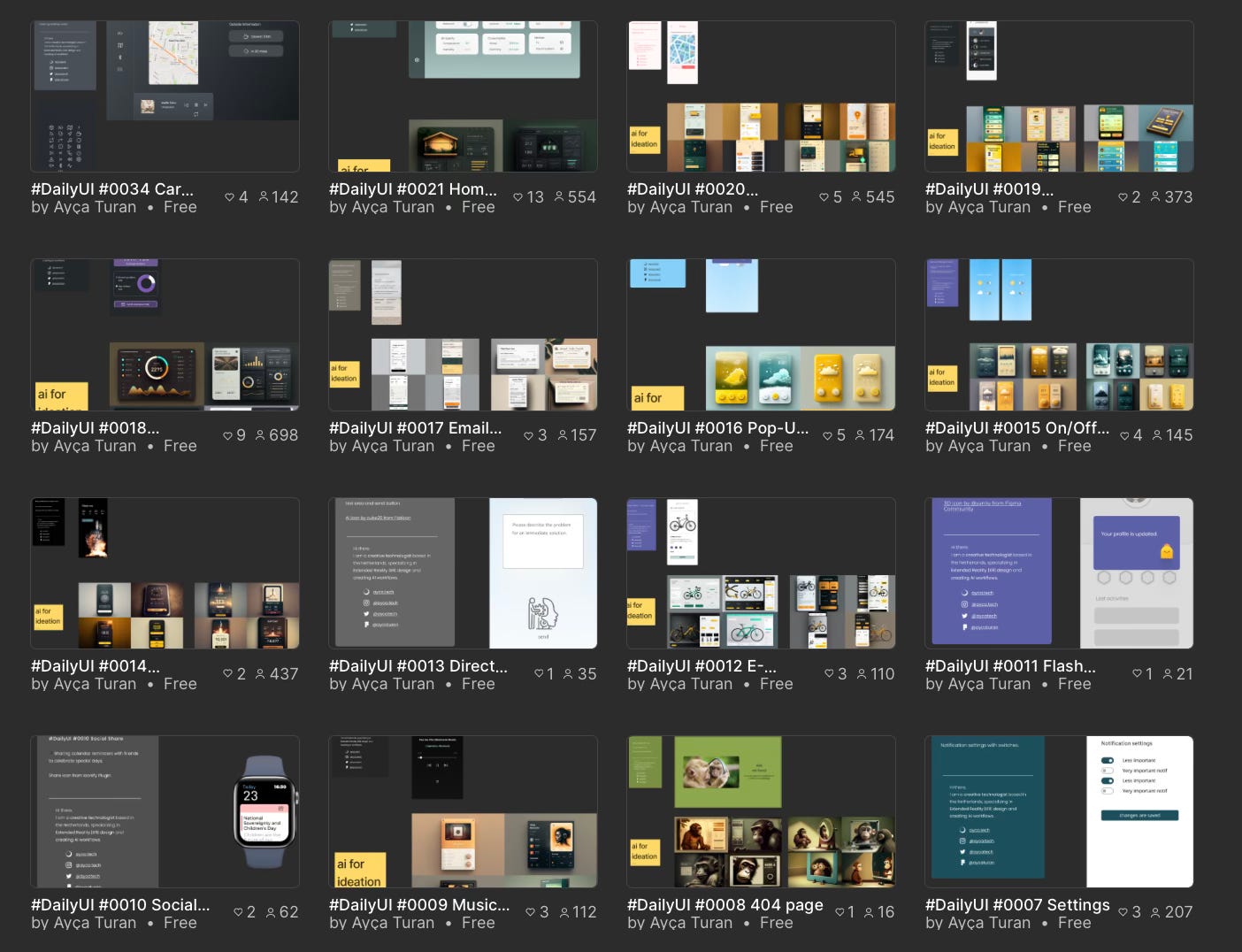
I started doing daily UI challenges (and stopped around day 40). I published them as community files on Figma.
What Helped and What Didn’t
During that time, I bought two courses within my budget: one on UX principles and methods intouxdesign by Anfisa and another sketching for ux by Krisztina. Both were genuinely good.
They supported what I was already trying to do. I already had some momentum and questions of my own. These courses helped me move forward.
Not every experience was like that.
I bought a Figma course by a creator. I thought if I “made the investment”, I would dedicate time to get better at a program that could make me money.
I never had the time or motivation to learn it.
When you start educating yourself, it’s very easy to buy courses immediately. Everyone has great material. Everything feels necessary.
Often, you don’t yet know what you actually need.
My point is there are many high-quality free resources online. That’s an opportunity. The challenge is the direction which usually only appears after you start doing things.
Learning From Communities
After courses, I realized I should get involved with design communities and networking. I joined a UX community where I could pitch my projects, get feedback on my portfolio and listen to live sessions.
These were people I could learn from by following their journeys into design.
Later, it didn’t make sense to pay 15 euros per month to be part of a group when I already had a limited budget.
What I gained from that experience was something valuable: an experimental buddy system. For a few months, we met every two weeks, three designers in different time zones and at different points in their careers.
We shared our current struggles and our goals.
That part was good.
Experimenting With Different Mediums
At the same time, I started making AR effects. I enjoyed it and I published things.
As I went deeper, I realized I didn’t enjoy how structured UX design could feel. Expecting innovation through a rulebook felt limiting. That’s when UX for Extended Reality became more interesting to me. It was still being researched. Nothing was set in stone. There was room to question and experiment.
As my AR effects evolved, I had more complex visions in my head.
I didn’t know how to 3D model, so I started that famous donut course to learn Blender.
At first, it was fun.
Then it became more complex.
My donut didn’t look like the one in the video.
I got frustrated.
I had some clay at home. I made a donut with my hands and thought: I wish there was an easier way to scan this and turn it into a 3D model.
Later, I discovered photogrammetry.
I could scan objects and create 3D sculptures while working with memory and physical space. Over time, the technology evolved: photogrammetry, NeRFs and nowadays Gaussian Splatting.
The idea stayed the same: capturing reality and turning it into something you can walk into.
This is how these experiments actually connected for me.
Experimenting With Different Practices
Another course I took was on creative coding by Tim Rodenbröker. It had a community aspect on Discord, which made networking easy.
I also went to Creative Coding Utrecht Open Day, saw people create visuals with Processing and Hydra and experienced how creative coding could performed live.
Around the same time, I attended an event focused on TouchDesigner, which was especially inspiring. What struck me was seeing artists use the same tool for completely different expressions: installation, performance, visuals, sound.
Later next summer, I followed a TouchDesigner course organised by Music Hackspace, facilitated by Kyle Duffield.
If you talk to anyone who has spent time with the program, they will almost certainly mention elekktronaut at some point.
After a while, I realized I couldn’t fully align creative coding with what I was exploring at that moment. So I paused, thinking it could become useful later.
Do you see how experiments start talking to each other after some time?
Somewhere along the way, I started calling myself a Creative Technologist.
For me, the easiest way to learn has always been following what inspires me and trying to replicate it in my own voice. Courses worked best when they supported that process.
Looking back, I think the role of a teacher or a course, is not to give you the path.
It’s more like this: “Once you’re out of formal education, you’re in a dark room. A teacher is someone who has a bit of light and a rough idea of what the room might look like.”
They can help you see a corner or avoid bumping into something.
The room is different for each of us.
You still have to walk it yourself.
If there’s one thing I’ve learned: “It’s to follow your own red thread and keep going.”